Hotline: +381 61 63 84 071




This award belongs to the women who dared to speak
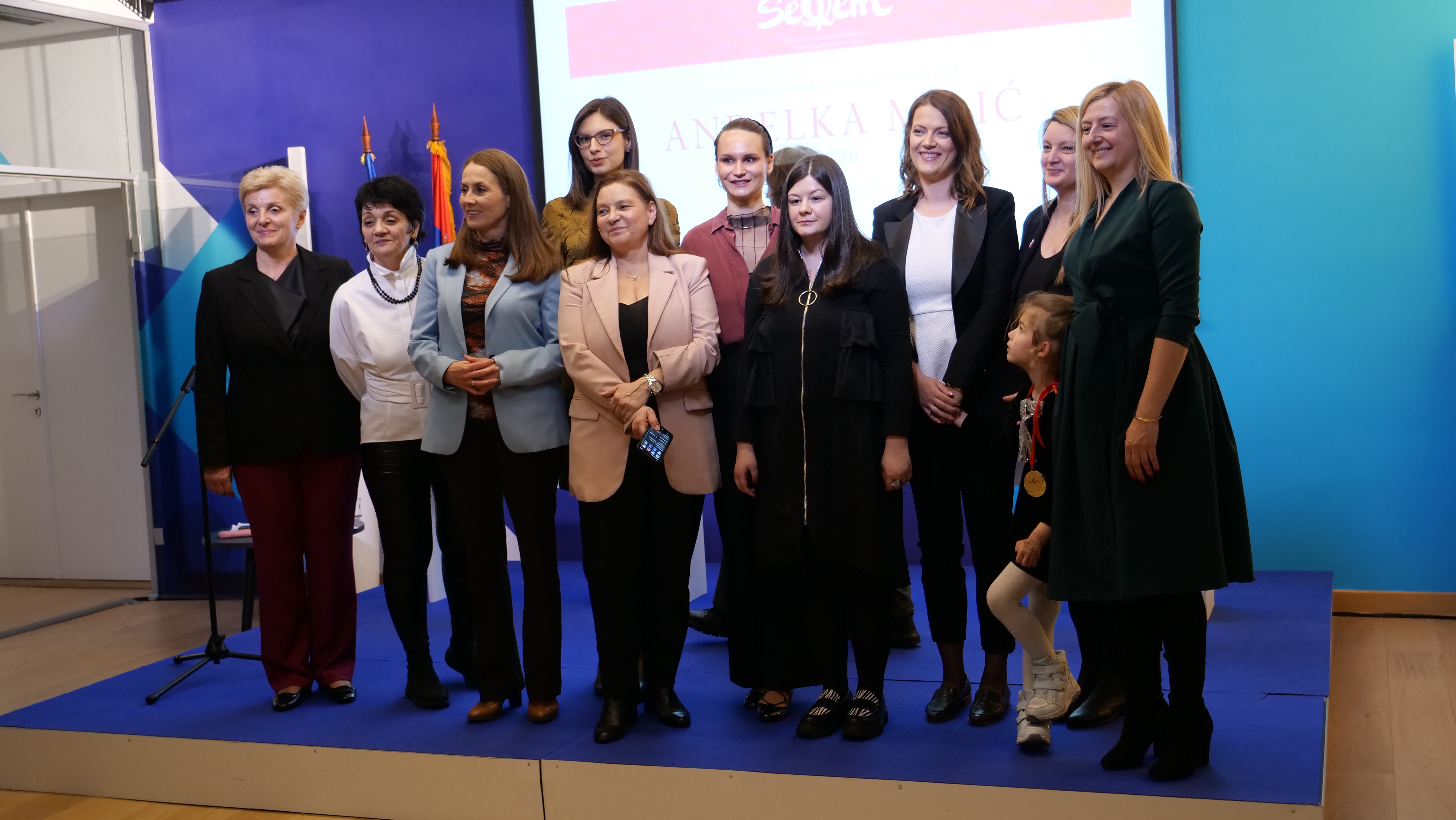
Women recipients of the Anđelka Milić award for 2026
This award belongs to the women who dared to speak
Photos made by Andjela Zubac
Speech by Jelena Hrnjak, Program Manager at NGO Atina, on the occasion of receiving the "Anđelka Milić" Award for the monograph Care in Crisis, Belgrade, April 2, 2026.
Dear all,
As you know, this monograph, Care in Crisis and why we must rethink institutional ethics towards women and girls who have survived human trafficking in Serbia during the Pandemic, was written by two Jelenas and one Andrijana, my colleagues Jelena Ćeriman, Andrijana Radoičić Nedeljković, and myself.
We wrote it in solidarity, with care and responsibility, and with the support of those who believe in our work. We wrote it together.
Whenever we encountered a problem, I would ask Jelena (Ćeriman) what we should do, and she would say, "Just lean on me." When I asked Andrijana, she would say, "We will do it together." That sentence, which is a solid rock, "We'll do it together," shaped…shaped not only this work, but everything we do.
We want to begin by expressing our gratitude for the legacy of Professor Anđelka Milić. We grew up and developed through her work, her struggle, and her teaching, as well as through the words and actions of her contemporaries who shared that struggle. Even today, we stand on their shoulders, on the shoulders of that fight. They paved the way for us and made it possible for us to be who we are and where we are.
Jelena Ćeriman is a researcher at the Institute for Philosophy and Social Theory, University of Belgrade. Andrijana Radoičić Nedeljković is a psychotherapist and social worker from the Association of Systemic Therapists. For the past 17 years, I have been leading NGO Atina, an organization dedicated to the protection of victims of human trafficking.
I will take the liberty of calling the three of us "Atinjanke" as well as some of the award recipients present here tonight, our closest collaborators and allies in the values that bring us together: the protection of women who have survived human trafficking and all forms of violence against women.
I mentioned the word pandemic. It belongs to our recent past. It came, and it ended. But the Pandemic of violence against women does not end. Wars begin and end, but violence against women persists. There are countless women in Serbia living with violence, and it does not stop. Today, women in Serbia continue to experience male violence, and very often, that violence does not end; it only changes form.
With that in mind, I would like to thank the women with lived experience of trafficking who placed their trust in us. Because this award does not belong only to this monograph, it belongs to the women and girls who dared to speak.
Their experiences are not only testimonies of violence. It is a knowledge that reveals how systems function at their worst, in crisis, in isolation, in moments when protection should be strongest.
This monograph reveals an important, yet often unspoken truth: institutions that do not understand trauma can become part of the problem. And in those moments, violence changes its form, and the line between those who perpetrate harm and those who fail to protect begins to disappear.
The Pandemic did not create this. It exposed it.
That is why this monograph is not only research. It is a call.
A call to rethink how we understand care. How we build systems. And whom we choose to trust when making decisions. We chose to trust women who have survived trafficking, not as sources of data, but as authors of knowledge.
And that is precisely why this book does not end with analysis; it opens space for change.
It is proof that these women's struggle is not in vain. Without them, this award would have no meaning. And this award is proof that our struggle is not in vain either.
Let me come back to the issue of institutional ethics. Those who work within institutions must urgently break free from the culture of silence that overrides ethics, a culture that, at its core, is a lack of culture altogether. And all of us must continue to remind them that the absence of accountability is the key problem we must address today.
Let us be clear: the greatest problem is not the lack of knowledge, but the lack of a courageous system that protects victims, not institutions.
I will return to the beginning and once again thank Professor Anđelka Milić, whose work marked the struggle for dignity, equality, and the voices of those society often refuses to hear. This is proof that her struggle was not in vain.
Many struggles still lie ahead of us, including the student movement, which we support and must not be in vain.
Because the struggle does not end when we receive recognition.
It begins where the system remains silent.



 FACEBOOK
 TWITTER
 YOUTUBE