Hotline: +381 61 63 84 071




From trauma to testimony: Guidelines for psychological support to trafficking survivors in criminal investigations and court proceedings
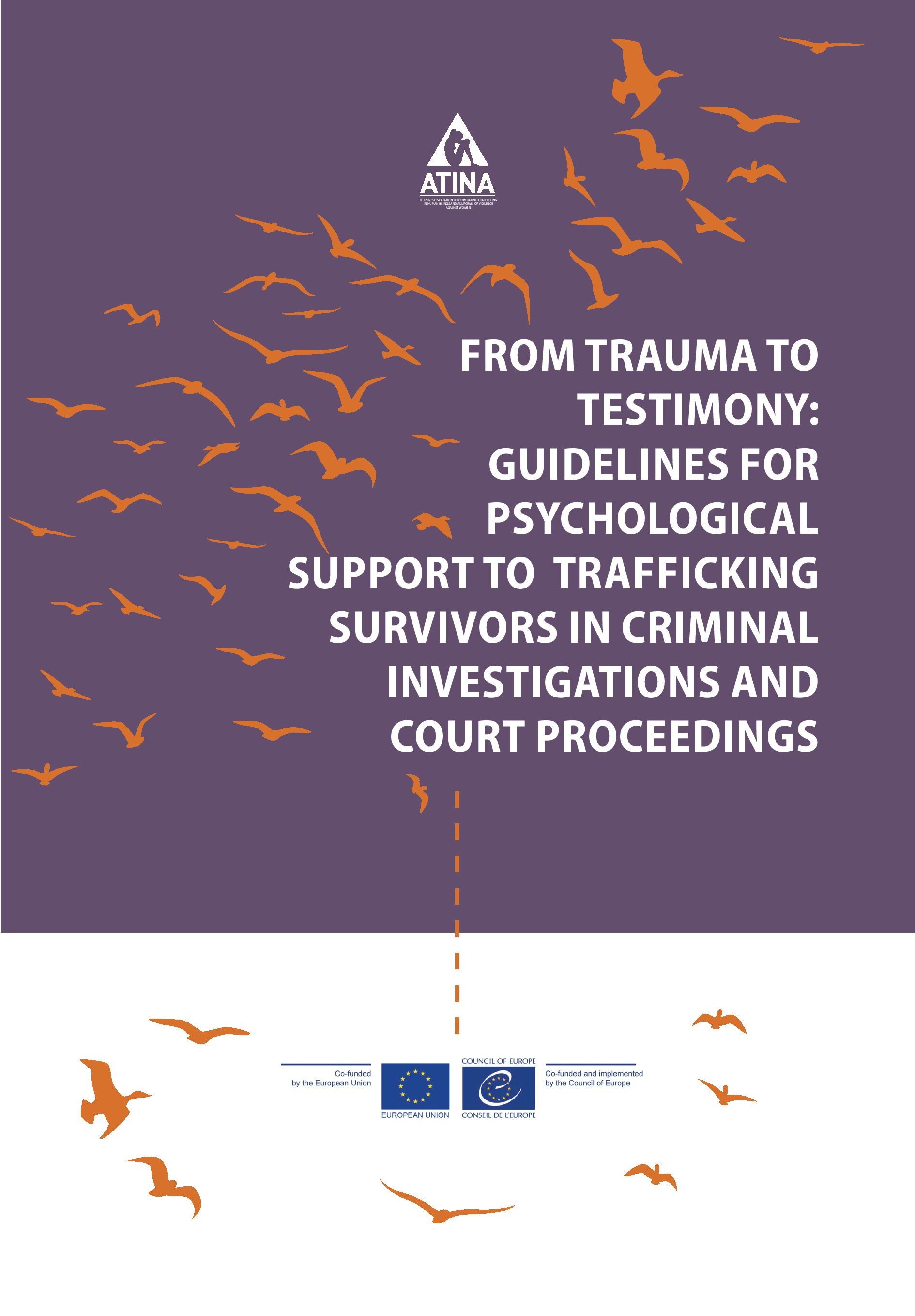
From trauma to testimony: Guidelines for psychological support to trafficking survivors in criminal investigations and court proceedings
NGO Atina is presenting the new publication “From trauma to testimony: Guidelines for psychological support to trafficking survivors in criminal investigations and court proceedings” (Belgrade, 2026), which emphasizes that the quality of judicial proceedings and the psychological well-being of victims are not competing goals but inseparable. Without a trauma-informed approach, there can be no safe testimony, no reliable statement, and no fair outcome.
This publication was developed within the project “Improving Access to Justice for Victims of Human Trafficking”, implemented by Atina as part of the project “Strengthening Anti-Trafficking Action in Serbia”, carried out within the joint programme of the European Union and the Council of Europe “Horizontal Facility for the Western Balkans and Türkiye” (2023–2026).
How the Guidelines were developed
The Guidelines emerged from NGO Atina’s everyday practice and long-standing experience in supporting trafficking survivors, in cooperation with institutions and through an interdisciplinary approach that connects psychological support, legal protection, and long-term recovery and reintegration. A particular value of this publication is that it does not remain at the level of procedures; it focuses on people: their needs, fears, dilemmas, and strengths, and insists on the victim’s right to voice, choice, and dignity at every step of the process.
The publication is intended for professionals in the judiciary, police, social and health services, civil society organisations, and all those who come into contact with victims of human trafficking, to reduce secondary victimisation and strengthen trust in institutions.
Why psychological support is essential in proceedings
Participation in criminal investigative and court proceedings is one of the most demanding and sensitive experiences in the recovery process for victims of human trafficking: testimony is crucial for justice, yet it often means confronting trauma, fear, and a loss of control all over again. The publication emphasises that while formal support mechanisms exist within the system, they are often limited to short, time-bound interventions. Victims, however, need continuous, comprehensive, long-term models of support that do not end upon “entering the courtroom” or with the giving of a statement.
At NGO Atina, psychological support has been an integral part of our programme since 2003. It has been developed in close collaboration with other forms of assistance, because a person who lacks safe accommodation or basic means of subsistence cannot, at the same time, endure the deep psychological processes that recovery entails.
What the publication contains
The publication is structured into three interconnected sections to provide a complete overview of the topic. The first section outlines Atina’s principles of work and the framework for trauma-informed, long-term support for victims in the context of investigations and trials. The second section provides basic information on 15 survivors of human trafficking who took part in the research. The third section systematises their experiences from investigative and judicial proceedings. It concludes with recommendations to improve practice and reduce secondary and repeated victimisation, offering readers a full scope “from context to solutions”.
The introduction explains that Atina’s approach to preparing victims is based on principles that are not merely “individual skills”, but embedded in the organisation’s structure and working methods to ensure consistent and stable support. Preparation is a comprehensive, long-term process; only then can testimony have a protective (and potentially therapeutic) effect, rather than becoming an additional retraumatising experience. The key is individualisation: immediately upon entering the programme, a needs assessment is conducted together with the beneficiary,y and an individual support plan is developed. Within this framework, preparation for testimony is carried out by a social worker and a psychologist, with clearly defined and harmonised roles.
Who was interviewed
The empirical section is based on interviews with 15 people who went through different phases of investigative and/or court proceedings (87% women, 13% men; most in the 31-40 age group), with four of them being minors at the time they entered exploitation. The most common pre-existing vulnerabilities included poverty/unemployment or homelessness, and family and/or sexual violence. Exploitation in most cases took place in Serbia. Sexual exploitation dominates the sample (around 80%), often combined with multiple forms of exploitation. In total, respondents spent 608 months in exploitation (50 years and 8 months). Of the 15 cases, 8 trials have concluded, and 7 are ongoing (several cases have been ongoing since 2022), with repeated proceedings and documented attempts at intimidation.
Key messages that survivors emphasise to the system
Survivors clearly communicate to the system that the police are most often the first point of contact and therefore must act consistently in a trauma-informed manner; experiences range from careful approaches to situations that further victimise. Institutions also usually fail to provide basic, clear information about procedures, and for two-thirds of participants, the first clearer understanding came only through support from Atina’s social workers.
Survivors describe court proceedings as unpleasant and often retraumatising, accompanied by fear, helplessness, and confusion. They call for minimum standards: that intimate questions be announced and explained in advance, that fewer people be present in the room, that proceedings be shorter or include breaks, and that institutions coordinate to avoid repeatedly asking traumatic questions.
At the same time, interviews confirm that continuity of specialised support makes a decisive difference: 86% of participants had accommodation or supported housing provided through Atina, and for 60%, the key factor was the constant availability and the sense that “there is always someone who will respond to their calls and needs”.
Editor: Jelena Hrnjak
Authors: Dragana Ćuk Milankov, Jelena Radosavljev Kirćanski, Marijana Savić, and Lidija Đorđević
“This material has been produced with the financial assistance of the European Union and the Council of Europe. The contents are the sole responsibility of the author(s). The views expressed herein can in no way be taken to reflect the official opinion of the European Union or the Council of Europe.”

Download the publication (PDF):




 FACEBOOK
 TWITTER
 YOUTUBE